
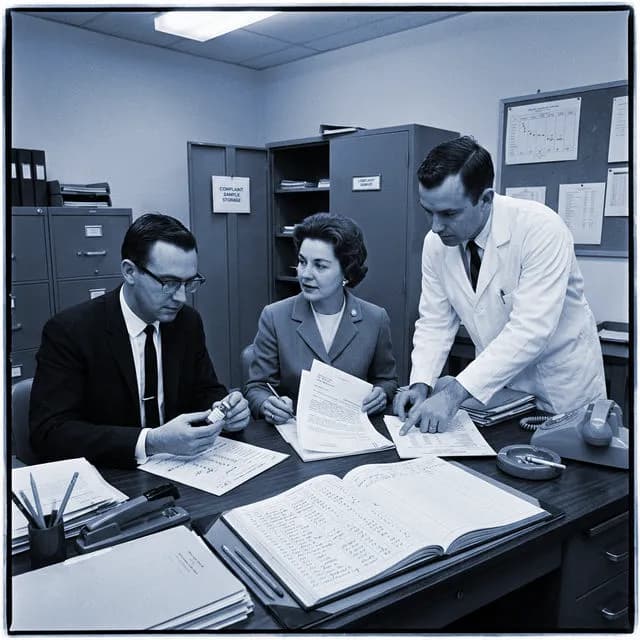
How do you capture, assess and close customer complaints in a compliant and complete manner?
We build a complaint management system that captures, assesses and closes every complaint with full documentation, in line with ISO 13485:2016 and MDR (EU) 2017/745. Where intake, reportability assessment and trending do not run as one process chain, the systematic product problem behind the individual cases goes unnoticed.
Overview
What do ISO 13485 and the MDR require from complaint management?
Complaint processes from intake to closing in line with ISO 13485:2016 clause 8.2.2 and MDR (EU 2017/745), integrated with vigilance, PMS and CAPA
Last updated: June 13, 2026
ISO 13485:2016 and the Medical Device Regulation (EU) 2017/745 require a systematic complaint management system that goes beyond customer service: every complaint must be captured, assessed, documented and closed with a traceable disposition.
- Complaints that are not captured or are filed without assessment. Clause 8.2.2 of ISO 13485:2016 requires a defined process for receipt, assessment and investigation of every complaint; an undocumented complaint is a direct audit and inspection finding.
- No process for assessing reportability. For every complaint it must be assessed whether a reportable serious incident under MDR Art. 87 is present; without a clear decision rule, this check remains unsubstantiated.
- No trend analysis across complaint frequencies. If complaints are only handled as individual cases, the systematic product problem that should trigger a field safety corrective action remains invisible.
- Complaints are not used as a PMS data source. Under MDR Art. 83–86, complaint data is one of the central inputs to post-market surveillance; if it is missing, the PMS plan, PSUR and PMCF evaluation are incomplete.
- Unclear definition of terms. Under clause 3.4 of ISO 13485:2016, a complaint is any written, oral or electronic communication alleging a deficiency in a product; without this clean delineation, reportable communications are misclassified as mere service requests.
Services
How we support you
Complaint system design & process setup
Building the complete complaint process in line with ISO 13485:2016 clause 8.2.2 and MDR requirements: intake, assessment, investigation, CAPA derivation, reportability assessment and closing. The deliverables are compliant SOPs and intake forms with defined responsibilities and deadlines.
Complaint backlog remediation
Structured processing of open and incompletely documented complaints, prioritized by reportability relevance and inspection risk. The deliverable is the closure of every complaint with complete investigation documentation and a traceable disposition.
How we work together
What it comes down to
The moment a complaint arrives, a reporting deadline starts running that nobody has yet confirmed applies. Intake must be followed by the reportability check: whether a serious incident is present, the reporting of which is governed by MDR Art. 87, determines the deadline and the escalation before the actual product investigation even begins.
Only after the reportability check do investigation, CAPA derivation and closing take effect. Push the reportability check to the end and the step with the shortest deadline is the one that slips; a late report then carries more weight than the complaint that triggered it.
The next stage in complaint handling jams at aggregation. A single, individually assessed complaint says little; only trending across frequencies pins down the systematic product problem that should trigger a field action. It is precisely this aggregated complaint data that, under MDR Art. 83–86, is a central input to post-market surveillance.
Because weak aggregation hides systematic product problems, we build the chain as a whole: a clean intake feeds the trending, the trending feeds PMS and CAPA, and the documented closure of every complaint keeps the backlog small, the backlog that in an inspection is otherwise the first visible evidence of a system that is not working.
| Possible outcome of the assessment | Meaning |
|---|---|
| not justified | documented decision without further action |
| Product investigation | technical examination of the affected product |
| CAPA | corrective or preventive action |
| Vigilance report | reported as a serious incident under MDR Art. 87 |
Our approach
Our approach
Step
Result
As-is assessment & gap analysis
Comparison of the existing complaint handling against ISO 13485:2016 clause 8.2.2 and the MDR; a prioritized gap list ranked by inspection risk.
Process & SOP design
A defined complaint process with SOPs, forms, responsibilities and deadlines from intake to closing.
Vigilance & PMS integration
A documented reportability assessment under MDR Art. 87 and the connection of complaint data to PMS under MDR Art. 83–86.
Trending & CAPA derivation
Established trending for early signal detection and the traceable derivation of CAPAs from confirmed complaints.
Backlog remediation
Open complaints processed by priority and closed with complete investigation documentation.
Common pitfalls
Where projects commonly fail
Complaints are filed without assessment.
Clause 8.2.2 of ISO 13485:2016 requires that every complaint is assessed and investigated; a complaint closed without a documented disposition is a direct inspection finding and can hardly be substantiated after the fact.
The reportability check is missing or undocumented.
Without a clear decision rule as to whether a complaint is a serious incident under MDR Art. 87, the reporting decision remains unsubstantiated, and a late or omitted report carries more weight than the complaint itself.
There is no trending across complaint frequencies.
If complaints are handled only individually, the systematic product problem behind the individual cases is overlooked; this very pattern triggers a field safety corrective action.
Complaint data does not feed into post-market surveillance.
Under MDR Art. 83–86, complaints are a central PMS data source; if they are not fed in, the PMS plan, PSUR and PMCF evaluation are incomplete and stand out in the surveillance audit.
The complaint backlog grows unnoticed.
Open and incompletely documented complaints pile up because prioritization and deadlines are missing; in an inspection, the unprocessed backlog is the first visible evidence of a system that is not working.
Quality Management & Compliance
Do any of these pitfalls apply to you?
In a first call we assess your situation and say what needs clarifying first in your case. Without obligation, reply usually within one working day.
FAQ
Frequently asked questions
Sources
- Regulation (EU) 2017/745 (MDR), primary text, Art. 83–86, 87
- ISO 13485:2016, Quality management systems for medical devices, clauses 3.4 and 8.2.2
Image notice: The images on this page were generated using artificial intelligence. They do not depict real people, places, or events.
Life Science Journal
Regulatory updates, straight to your inbox.
New requirements, authority decisions and practice notes. Once a month, unsubscribe any time.
Projects from this industry
What we have worked on in this industry


Related insights
All insights →Regulations & standards considered
- EU 2017/745 (MDR)
- MDR Art. 87 (vigilance, reporting of serious incidents)
- MDR Art. 83–86 (post-market surveillance)
- ISO 13485:2016 (QM system for medical devices)
- ISO 13485:2016 clause 8.2.2 (complaint handling)
- ISO 13485:2016 clause 3.4 (definition of complaint)
Related topics
Medical Device Vigilance →
Reportability assessment of serious incidents under MDR Art. 87
Post-Market Surveillance →
Complaint data as a PMS data source under MDR Art. 83–86
CAPA Management →
Derivation of CAPAs from confirmed complaints
Quality Management →
Embedding the complaint process into the QM system under ISO 13485:2016
Have a concrete project?
Briefly outline your situation. We'll respond with an initial assessment, usually within one business day.
Prefer direct? +49 89 4161170-0
info@theentourage.us
- Reply usually within one working day
- 4 locations: DE · CH · IT · US
- 100% life sciences