
Launch readiness in the supply chain: what should be in place six months before approval
Many prerequisites of a pharmaceutical launch have a lead time of 12 to 18 months, often more. What has to be complete in the supply chain six months before approval, what may still be in progress, and which three risks belong on the table.

Principal Consultant
In brief
A timeline from T-18 to launch, a checklist for governance and production, quality, procurement, planning, logistics and customer service, and three risks: delays in the approval procedure, bottlenecks during ramp-up and late text changes to the printed packaging materials.
Many prerequisites of a launch have a lead time of 12 to 18 months, often more, and cannot be made up at short notice. Six months before approval is an important and sensible checkpoint for the supply chain.
A pharmaceutical launch only succeeds if the supply chain can deliver on the day of approval. Many of the prerequisites, from qualified suppliers and validated processes to capacities and authorizations, have lead times of 12 to 18 months, and more depending on material and supplier. What is missing here cannot be made up at short notice.
Six months before approval, T-6 for short, is therefore the last sensible checkpoint. By then, the long-lead items must be complete. Whatever depends on the final approval texts, such as the printed packaging materials, may still be in progress, but in a controlled way and with agreed turnaround times. The checklist below describes this state for a launch from the company's own plant, from governance and production through quality and procurement to planning, logistics and customer service.
The timeline: what has to start when
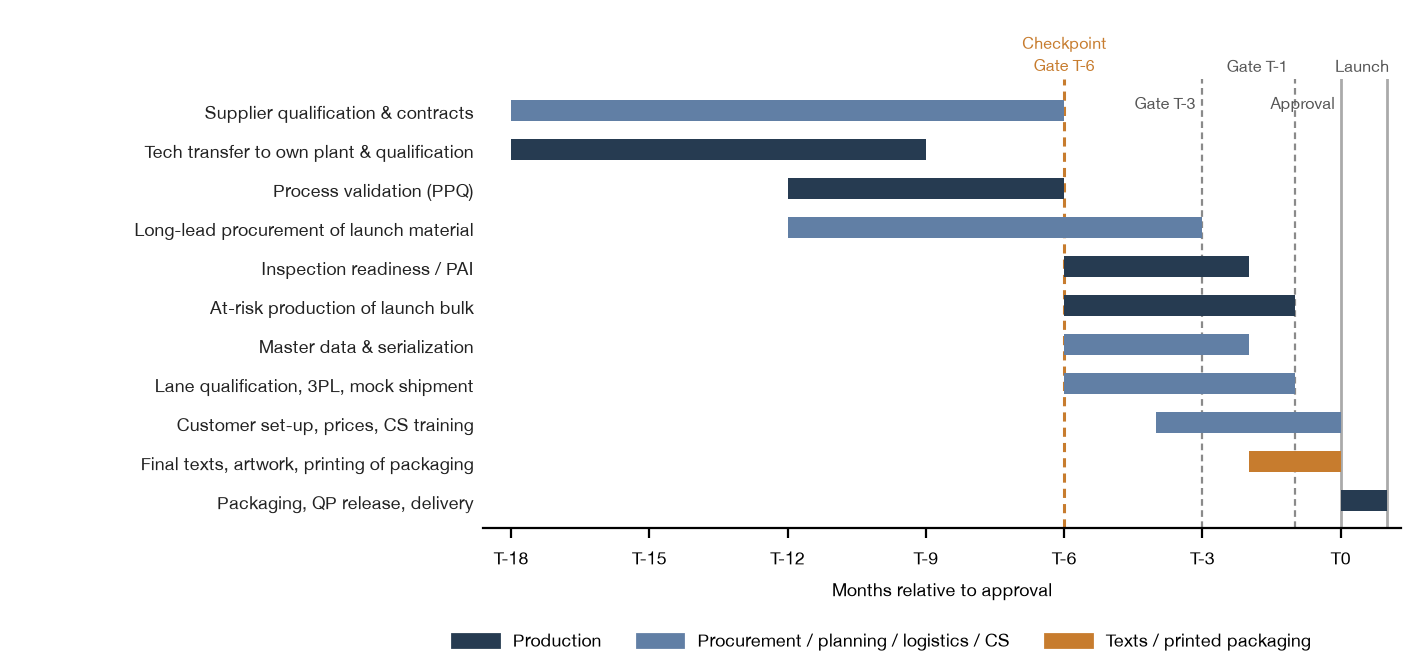
Supplier qualification and tech transfer start at least 18 months before approval, process validation and long-lead procurement about twelve months before, and earlier depending on material and supplier. From T-6, inspection readiness, at-risk production of the launch bulk, master data and any coding (serialization), and the qualification of logistics follow. Customer set-up, prices and customer service training run in the final months, final texts and the printing of the printed packaging materials at the very end. After approval, packaging, QP release and delivery remain. The timeline shows an ideal project; how early a step actually has to start depends heavily on the circumstances.
The logic of the checklist follows from this: what must be complete at T-6, and what may still be in progress at that point?
Governance and production
Complete at T-6: A launch readiness team is in place, with a launch plan, risk register and scenarios. In production, tech transfer, qualification (IQ/OQ/PQ) and process validation (PPQ) are complete. Capacities for manufacturing, packaging, QC lab and warehouse are confirmed, and staff are trained.
In progress at T-6: monthly reviews with fixed gates at T-6, T-3 and T-1; the manufacturing authorization and preparation for the pre-approval inspection (PAI); at-risk production of the launch bulk, and with it the settling-in of QC and QP release.
Quality: QA and QC
QA: Complete at T-6 are the appointment of the qualified person (QP) with a defined release process, the quality agreements with suppliers and 3PL, and an established QMS with SOPs, change control, deviation and CAPA management, training and supplier management. Still in progress are inspection readiness with mock inspection, site master file, self-inspection and data integrity, the release of the launch batches, and the complaint and recall process.
QC: Complete are the transfer and validation of the analytical methods and the qualification of the lab and LIMS. Still in progress are the final specifications, reference standards, the stability program and the testing capacity for release and incoming goods, including the text check of the printed packaging materials.
Procurement: three material groups, three points in time
In procurement, it pays to separate three material groups, because they can be fixed at different points in time.
- Active ingredient, excipients and primary packaging materials: The suppliers are qualified and compliant with the dossier, contracts and quality agreements are signed. Still in progress are the long-lead orders for the launch material.
- Unprinted secondary packaging materials such as outer cartons, shipping cartons, trays and inserts: The suppliers are qualified. The launch quantities can already be ordered, because they do not depend on the texts.
- Printed packaging materials such as folding cartons, package leaflets and labels: The printers are qualified, the templates are prepared. Printing only starts after the final texts. An express turnaround time of two to four weeks must therefore be agreed with the printers.
Planning, logistics and customer service
Planning: Complete are the launch forecast by country and scenario in S&OP and the setting of the shelf life. Still in progress are the decision between at-risk production and postponement, the inventory strategy and the allocation rules, as well as the master data in ERP, MES and WMS and serialization (GTIN/PPN, PZN/IFA, EMVS).
Logistics: Complete are the distribution model, the selection of the 3PL, the temperature concept, GDP and the wholesale distribution authorization. Still in progress are transport validation, the EDI connection of the 3PL and a mock shipment, as well as the returns and recall process including a mock recall.
Customer service and order-to-cash: Complete are the order-to-cash process and the sales channels. Still in progress are customer master data, prices and price notification (IFA, Lauer-Taxe), the interface to complaints and pharmacovigilance, customer service training and a dry run.
Three risks that belong on the table at T-6
These three risks are not the exception but reality in practically every launch. The reason lies in the approval procedure: the authority has several points in time at which it can intervene in the timeline of the procedure, for example by stopping it (clock stop) or by requesting text changes late.
- The approval procedure runs into delays. The reasons are above all extensive questions from the authority on the dossier, for example on quality, stability or clinical data, whose answers require additional studies or analyses. In addition, there are deficiencies found in the GMP inspection of the manufacturing or testing site, which have to be remedied first and, where necessary, re-inspected. Delays also arise when the applicant has to extend response deadlines or the authority misses its own deadlines because of overload.
- Production, packaging or the QC lab become the bottleneck during ramp-up. This is more the rule than the exception. A launch means manufacturing, packaging and releasing several batches of a new product under pressure. In production and packaging, the bottleneck is simply the quantity. In QC, it is often the new methods, and the first commercial batches are usually still validation batches at the same time, with a correspondingly longer turnaround time.
- A late text change delays the printed packaging materials. The authority may request a text change up to a few days before approval, and internal QC can only finally release the printed packaging materials after the regulatory approval. Every late change therefore hits the launch date directly.
The more important the product and the timing of market entry, the more risk is knowingly taken at this point. From practice: in several launches, printed packaging materials were ordered at risk, with internal release, and stored, in the hope that nothing would change in the texts. This gained two to three weeks.
If production is outsourced to a CMO or CDMO, a further prerequisite applies: a sound contractual agreement with that partner that covers all the points above.
Relevant for your project?
Similar questions in your current project?
In a first call we clarify what is specifically relevant for your situation, without obligation.
Request a call →Related expertise
Supply Chain Management →
Improve demand planning, inventory strategy and supplier steering in day-to-day operations.
Inspection Readiness →
Preparing for the site inspection: mock inspection, site master file, self-inspection
Good Distribution Practice →
Distribution, temperature control and qualification of partners under the EU GDP guidelines
Process Validation →
Qualification and process validation as the basis for the first commercial batches
Manufacturing & Supply Chain Management →
Production planning, supplier management and resilience across the whole chain.
Related projects
All case studies →

Sources
- Practical experience of the author in supply chain management and launch preparation in the pharmaceutical industry
Related insights
All insights →

Your project
Have a concrete project?
Briefly outline your situation. We'll respond with an initial assessment, usually within one business day.
Your inquiry goes to our team, which brings in the subject-matter experts as needed.
Prefer direct? info@theentourage.us
- Reply usually within one working day
- 4 locations: DE · CH · IT · US
- 100% life sciences