
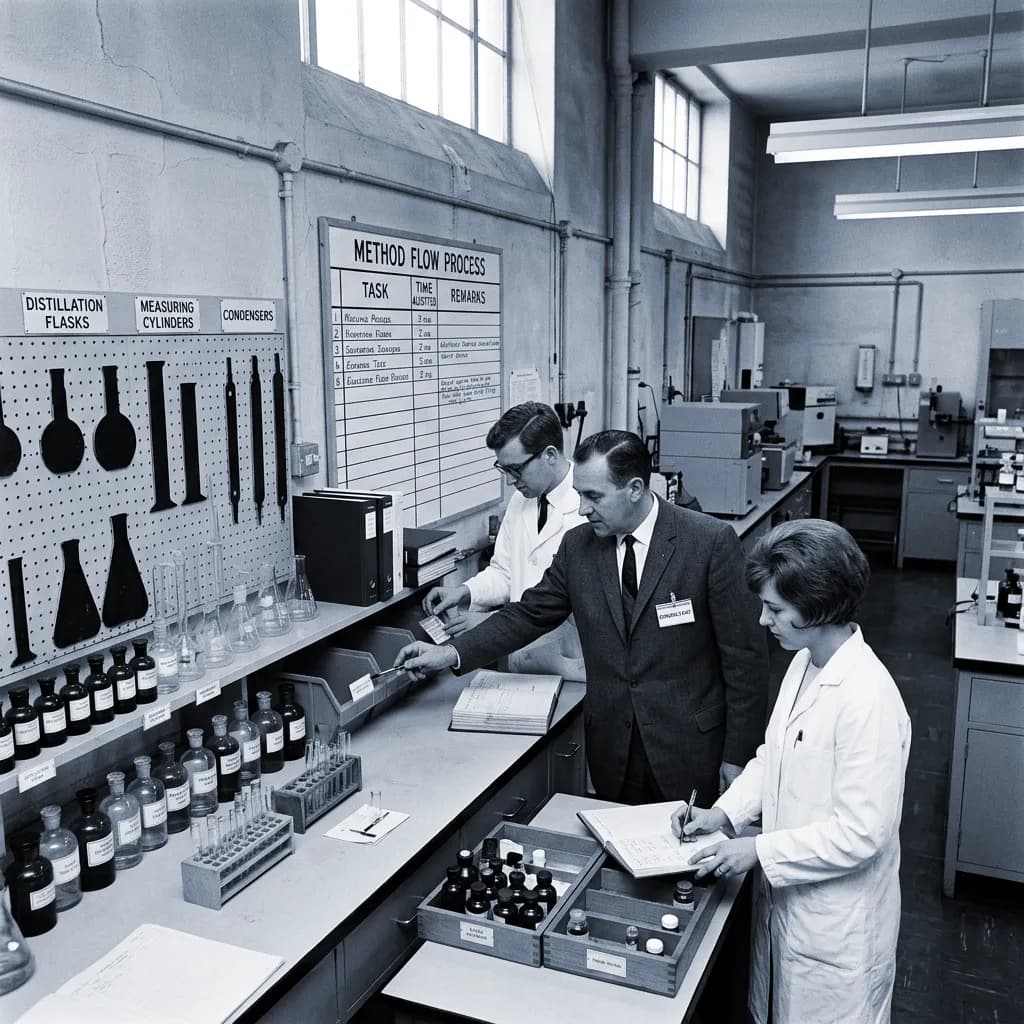
How can life sciences laboratories increase productivity through lean lab approaches without compromising quality and GxP compliance?
We bring Lean Lab to regulated laboratories: value stream analysis, 5S, scheduling optimization, documented in QC labs to EU GMP Guide Chapter 6. Introducing 5S or new scheduling without the validated state and change control turns into an audit finding instead of an efficiency gain.
Overview
What efficiency problems arise in regulated life sciences laboratories?
Lean optimization documented in line with GMP · Value stream analysis, 5S and scheduling in the regulated laboratory environment
Last updated: October 4, 2026
Laboratory processes in regulated environments are often less efficient than they could be, because waste is tied up in waiting times, search times and rework. In the GxP environment, there is the added factor that every process change touches a controlled state.
- Long waiting times between sample receipt and analytical result delay batch release, because the analytical result from the quality control laboratory (EU GMP Guide Chapter 6) is a prerequisite for release.
- Reagents and consumables are stored without structure; high search times and ambiguous storage locations make it harder for the quality control laboratory to keep to expiry dates and storage conditions, which EU GMP Guide Chapter 6 (point 6.21) expects on the label.
- Lack of laboratory planning leads to instrument bottlenecks and unused time slots, because sample routing and capacity planning are not aligned with one another.
- Non-value-adding activities such as searching, waiting and reworking tie up laboratory time without their share being systematically captured and measured against the documented workflows.
Services
How we support you
Lean Lab Assessment & Value Stream Analysis
Complete analysis of laboratory processes through value stream mapping, time studies, observation and staff interviews. Deliverable: quantified waste potential and a prioritized action list per laboratory area.
5S & Workplace Organization
Structuring of laboratory workplaces according to 5S (sort, set in order, shine, standardize, sustain). Deliverable: defined and labeled storage locations with associated change control documentation in the GxP environment.
How we work together
What it comes down to
Lean Lab in a regulated laboratory begins with a measurement. Before 5S storage locations are labeled or new scheduling is introduced, the value stream analysis must show where time is actually lost: in waiting times between sample receipt and result, in search times at unstructured storage locations, or in instrument bottlenecks.
Only this baseline makes the bottleneck visible. If you optimize past the bottleneck, for example by increasing the utilization of a single instrument, throughput to the release-relevant result does not improve, and the effort is wasted.
The second strand is the change impact assessment, which in the GxP environment belongs before every implementation.
Every 5S change to storage locations, every new standard operating procedure and every changed sample routing touches a controlled state and, in the quality control laboratory, must run through the change control system in line with the EU GMP Guide.
Pulling this assessment to the front separates the purely organizational measures early from those that require release approval, and prevents a well-intentioned efficiency step from ending up as an audit finding.
Our approach
Our approach
Step
Result
Assessment & value stream analysis
Quantified waste per laboratory area and a prioritized action list.
Change impact assessment
Clarified which measures touch the validated state and must go through change control in line with the EU GMP Guide.
5S & workplace organization
Defined, labeled storage locations and workplace standards, documented to the documentation principles of the EU GMP Guide (Chapter 4, for the laboratory point 6.7).
Scheduling & capacity planning
Documented scheduling concept with reduced waiting times and improved instrument utilization.
Training & champions
Trained laboratory staff and designated internal owners to carry the work forward.
Effectiveness measurement
First measurement of the improvement against the documented baseline state.
Common pitfalls
Where projects commonly fail
5S is introduced as a mere tidying-up exercise, without reference to the controlled state.
If storage locations, labeling or standard operating procedures are changed without change control in line with the EU GMP Guide, the result is an audit finding rather than an efficiency gain.
The share of non-value-adding activities is estimated rather than measured.
Without value stream analysis, time study and observation, waiting times and search times remain invisible, and measures fail to address the laboratory's actual bottleneck.
Scheduling optimization is applied in isolation to individual instruments, without accounting for sample routing through the quality control laboratory all the way to the release-relevant result.
Local utilization rises, but throughput to the analytical result that permits batch release does not improve.
Lean is treated as a one-off project.
Without trained internal champions and a fixed improvement rhythm, the workflows fall back into old patterns after a few months, because the culture is not embedded.
Improvements are not measured against a documented baseline state.
Without a baseline, the effect can neither be demonstrated to management nor traced in a later effectiveness check.
Supply Chain & Technical Operations
Do any of these pitfalls apply to you?
In a first call we assess your situation and say what needs clarifying first in your case. Without obligation, reply usually within one working day.
FAQ
Frequently asked questions
Sources
- OECD Principles of Good Laboratory Practice, Annex I to Directive 2004/10/EC (scope: non-clinical safety studies), and German Chemicals Act, section 19a(1)
- EU GMP Guide (EudraLex Volume 4), Part I with Chapter 1 (change control), Chapter 4 and Chapter 6 Quality Control, Part II Chapter 11 (laboratory controls for active substances), primary text
- ISO 13485:2016, Quality management systems for medical devices
- ISO 9001:2015, Quality management systems, continuous improvement
Image notice: The images on this page were generated using artificial intelligence. They do not depict real people, places, or events.
Life Science Journal
Regulatory updates, straight to your inbox.
New requirements, authority decisions and practice notes. Once a month, unsubscribe any time.
Related insights
All insights →Regulations & standards considered
- OECD Principles of Good Laboratory Practice (OECD GLP), only for test facilities conducting non-clinical safety studies
- EU GMP Guide, change control within the pharmaceutical quality system (EudraLex Volume 4, Chapter 1)
- EU GMP Guide Chapter 6 (quality control / laboratory area)
- ISO 13485:2016 (QM system for medical devices)
- ISO 9001 (QM system, continuous improvement)
Related topics
Lean Six Sigma →
Lean and Six Sigma as a broader approach with DMAIC and value stream analysis
Continuous Improvement Programs →
Embed a culture of improvement for the long term instead of one-off projects
Good Laboratory Practice (GLP) →
GLP applies to test facilities for non-clinical safety studies, not to the QC lab
Lean Manufacturing →
Lean principles in GMP manufacturing beyond the laboratory
Have a concrete project?
Briefly outline your situation. We'll respond with an initial assessment, usually within one business day.
Prefer direct? +49 89 4161170-0
info@theentourage.us
- Reply usually within one working day
- 4 locations: DE · CH · IT · US
- 100% life sciences