
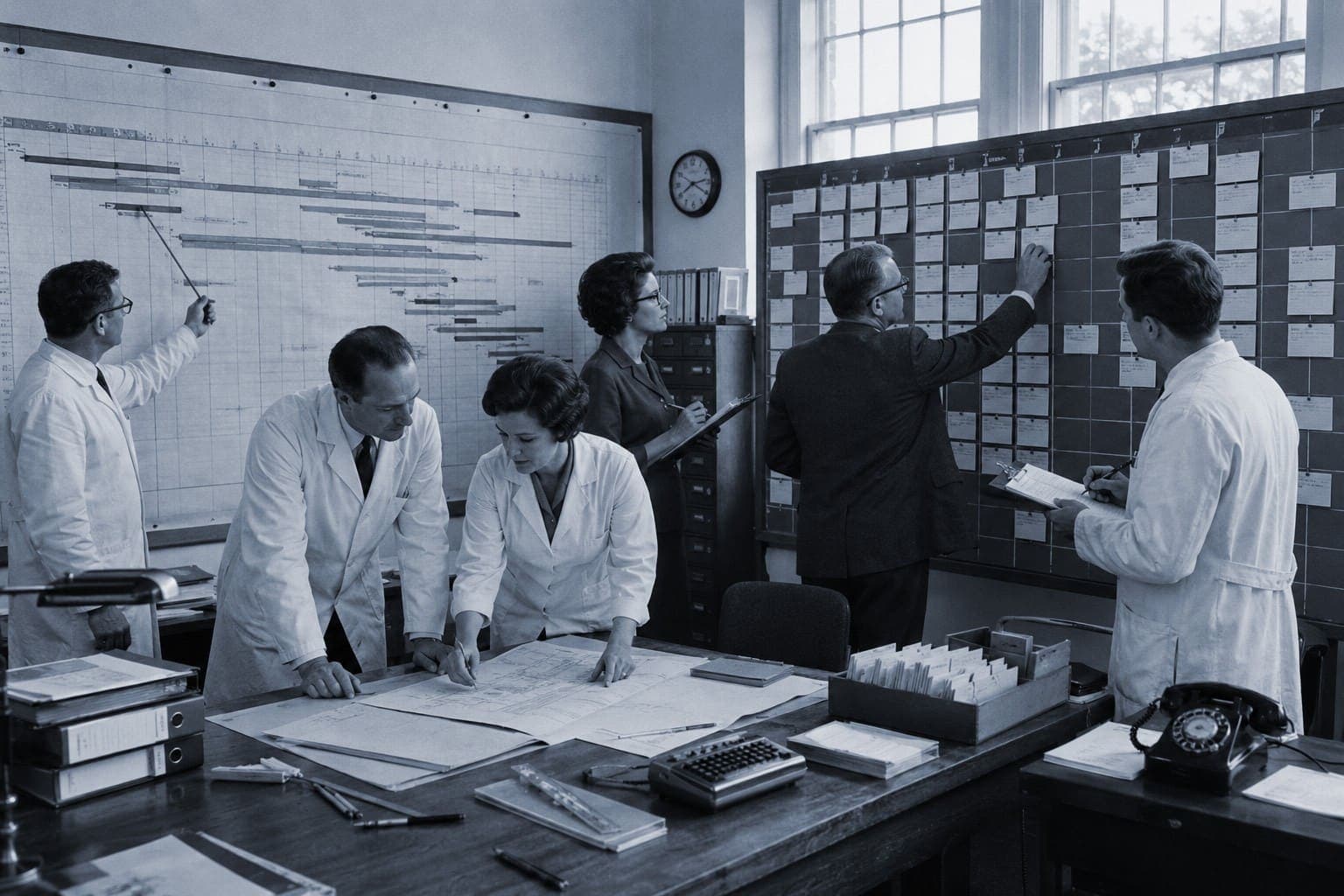
Agile or Waterfall? Why Pharma Projects Must Align the Method With the Question
Whether waterfall or agile is the right approach is not decided in pharma projects by method preference, but by the regulatory character of the undertaking. Where validation-driven projects need structure, where digitalization benefits from iteration, and why the hybrid approach usually wins.
Entourage Editorial Team
In brief
When the linear waterfall model is superior in validation- and documentation-driven pharma projects, where agile plays to its strengths in digitalization efforts, and how a hybrid approach combines GxP documentation with iterative delivery.
The question of whether a pharma project should be run agile or according to the waterfall model is often debated as a matter of method or culture. That falls short. In an environment shaped by regulatory requirements, extensive documentation, cross-functional teams and patient safety, the regulatory character of the undertaking decides, not the project manager's preference. The method is a dependent variable, not the first decision point.
When Waterfall Is the Superior Choice
The waterfall model is a linear, phase-based approach: requirements, design, development, testing and implementation are completed one after another. In the pharmaceutical industry it is the preferred approach wherever high regulatory control, end-to-end documentation and validation are paramount:
- Implementation of validated IT systems such as LIMS, DMS, QMS, RIM or ERP.
- Qualification of equipment and validation of production lines.
- Projects with a fixed scope and clearly defined requirements.
- Preparation for authority inspections by FDA, EMA or WHO, with validation to GAMP 5.
Its strength is at the same time its limit: the clear documentation chain and the structured sequence fit the audit logic exactly, yet flexibility is low, late changes are expensive, and a usable result only becomes visible late.
Where Agile Works in Pharma
Agile delivers in short iterations, with frequent feedback and continuous involvement of those concerned. In a regulated environment, it plays to its strengths above all away from the validation-critical core:
- Digital initiatives such as CRM, BI or BPM systems.
- Internal IT development and process automation.
- Pilot projects and undertakings with evolving requirements.
- Digitalization projects with a quick contribution to value.
The advantage is early benefit, easily integrated feedback and high transparency about progress. The limitation is just as clear: agile presupposes experienced, mature teams, is not readily compatible with GxP documentation and calls for additional controls in order to meet regulatory requirements.
The Decisive Difference Lies in the Concept of Error
The deeper reason for this limit lies in the origin of agile. The method comes from software development, where an error usually means a bug or a missing function, and iteration, testing and learning from mistakes follow logically. In drug development, an error can concern patient safety. For this reason, the agile mindset cannot be transferred unchanged to clinical trials, drug development or manufacturing validation: there it must be supplemented by strict controls and compliance evidence, otherwise the approach loses precisely the safeguards that the regulated environment demands.
The Hybrid Approach Wins Most of the Time
In practice, many pharma projects are therefore run in a hybrid manner. Documentation, validation and regulatory traceability follow the waterfall logic, while task management, team collaboration and feedback loops are organized in an agile way. This keeps the work reviewable and audit-ready, while the project delivers value iteratively and stakeholders are more closely involved. Which mix is right follows from a few factors: type and scope of the project, regulatory requirements, structure and maturity of the team, degree of customer involvement and clarity of the requirements.
How Entourage Supports You
We do not start with the method, but with the question: which part of the undertaking is validation- and documentation-driven, and which benefits from iteration? From this separation we derive the appropriate approach, anchor the GxP-relevant evidence to GAMP 5 and Annex 11 in the structured strand, and organize the development- and digitalization-related parts in an agile way. This creates a project structure that does not play control and speed off against each other, but gives each work strand the logic that fits it.
Image notice: The images in this article were generated using artificial intelligence. They do not depict real people, places, or events.
Relevant for your project?
Similar questions in your current project?
In a first call we clarify what is specifically relevant for your situation, without obligation.
Request a call →Life Science Journal
Regulatory updates, straight to your inbox.
New requirements, authority decisions and practice notes. Once a month, unsubscribe any time.
Regulations & standards considered
- ISPE GAMP 5 (Computerised system Validation)
- EU GMP Guidelines Annex 11 (Computerised Systems)
Related projects
All case studies →
Sources
- ISPE GAMP 5: risk-based approach to the validation of computerised systems
- EU GMP Guidelines Annex 11: requirements for computerised systems
- https://theentourage.de/pharma-projektmanagement-agile-wasserfall/ (original Entourage article)
Related insights
All insights →
Your project
Have a concrete project?
Briefly outline your situation. We'll respond with an initial assessment, usually within one business day.
Prefer direct? +49 89 4161170-0
info@theentourage.us
- Reply usually within one working day
- 4 locations: DE · CH · IT · US
- 100% life sciences